Like most of my senior-year peers in Georgia Tech physics, I spent a good part of this past fall semester applying to graduate programs. This was a historically tough application cycle (more on this later), any my own applications were a little unconventional, so I want to spend some time going over them and discussing the broader circumstances.
My Applications
Even though I’m a physics major, most of my research experience is actually in computational chemistry, comprising about two years total by the time of application submission. Also, about a year ago, I began to get interested in computational and theoretical neuroscience, and I decided to pursue this as a potential avenue as well. As a result partially of my indecisiveness and partially of my lack of confidence in my ability to get into fields outside my primary one, I spread out my applications over 13 programs: 5 in physics, 3 in chemistry1 1. I originally had two more in chemistry, UC Berkeley and Northwestern, but I dropped these when I discovered shortly before the application deadline that they required the general GRE. , and 5 in neuroscience. Out of the 13 programs I applied to, I was accepted to one (Stony Brook physics) and rejected by the other 13 (five of these after interviews). Here are some relevant details of my profile:
- GPA: 4.0.
- Research: 2 years in computational chemistry research; 1 first-author publication in the Journal of Chemical Theory and Computation.
- Statement of Purpose: Pretty good, according to multiple reviewers, but could have used some improvement.
- Recommendations: Two from computational/theoretical chemist research advisors; neither is a super big name but both think well of me. One from a neuroscience professor with whom I took a project-based class.
- Leadership/Other: Society of Physics Students treasurer in my senior year and math/physics TA in junior/senior year.
Overall, I think I have a solid profile, but there are three main things holding it back. First, as mentioned, my statements of purpose could have used some improvement; in hindsight, I should have showed more passion and understanding of the relevant field(s). Second, in terms of fit, my application was geared towards computational methods development in condensed matter physics. My sense is that most of the “serious”/heavy computational methods development in physics is in fields like astrophysics and high energy physics, whereas condensed matter physics software development is more incidental to applied work. Finally, my recommendations are less than ideal—I’m not sure how much the physics and chemistry programs care about a neuroscientist’s recommendation, and vice versa. This is probably the greatest factor holding me back. I also am not the greatest in interviews, but this is obviously not a factor for the eight programs that denied me without an interview.
Broader Landscape
It’s conventional wisdom among everyone I speak to that this year is particularly bad for admissions. I’m curious to see how much of this is actually true and how much is just accepted because of the general bad vibes in academia right now. Unfortunately, hard numbers are hard to come by, since many universities haven’t yet published their admissions statistics; the only one I found numbers for was Georgia Tech, which did not significantly reduce physics Ph.D. admissions from 2025 to 2026.
There are other clues we can use, though. Some universities are indeed facing steep cuts: In November, Harvard’s science division announced it would cut Ph.D. admissions by 50%. Excluding the business school, MIT’s 2026 enrollment is down 20% compared to 2024. Changes are visible on a broader scale, too. In a survey of astronomy programs by the American Astronomical Association, 34 out of 90 respondents indicated they expected their 2026 class to be smaller than the 2025 one; just one program expected a larger class size. A study from the American Institute of Physics showed an enrollment drop of 7–9% from 2024 to 2025.
In a time of great uncertainty, we should be careful when trying to draw conclusions from incomplete data. Last year’s expectations and trends may not be accurate predictors of this year’s admissions. That being said, the general picture that emerges is that the fall 2026 admission cycle saw a modest but not cataclysmic drop in admissions, concentrated more heavily among top programs. Note that a ~10% drop in enrollment could be indicative of a larger drop in admissions rates, because students who would have gotten into better-ranked programs in previous years might “settle” for lower-ranked programs2 2. It’s good to note that when the AIP tried to predict the impact of funding cuts, they found a greater effect at private universities, which include more of the “elite” schools. .
Lessons Learned
I mentioned above some weak points I see in my own application. But what should I have done differently, and what can current students do to better prepare themselves? Based on my conversations with faculty and graduate students, I’ve tried to distill the most essential points below.
- Undergraduate institution matters: Not so much because of the name itself, but because of the faculty there. Letters of recommendation from PIs with connections go a long way. If you’re at a “weaker” institution, try to find the research advisors with bigger names.
- Research fit: I strongly suspect that a major factor in my admission to Stony Brook was that the research experience and goals I spoke about in my statement of purpose aligned closely with that of a specific faculty member there (who happened to have funding). If you plan to switch research areas, the application process is not the time to do that; worry about it after you’re admitted.
- Don’t underestimate the competition: In theory (my area), it can seem like every other person you meet at an open house has been learning quantum field theory since they were in kindergarten; I’m sure experimentalists have a similar experience. Some people are very far ahead of the curve.
- Never count yourself out: Graduate school admissions are opaque, holistic, and (especially in a field as small as theoretical physics) greatly affected by random factors: Maybe you, a thin films person, just happened to apply in a year in which MIT really needed a thin films person. Yes, the people in point 3 exist, but I also have seen people whose “public-facing” profile doesn’t seem extraordinary (somewhat low GPA, no publications, etc.) do very well3 3. To be clear, I don’t mean to imply that these students are any less capable than other, just that they do not match the typical picture of a “good applicant.” .
Chart: The Economist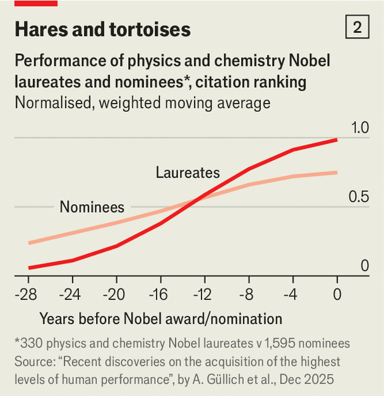
In the end, even though things didn’t go exactly how I wanted them to, I ended up okay (one admission is far better than zero!). I made many missteps along the way; I hope that this essay can help you avoid repeating mine. If you are applying to graduate school soon, I wish you the very best of luck.